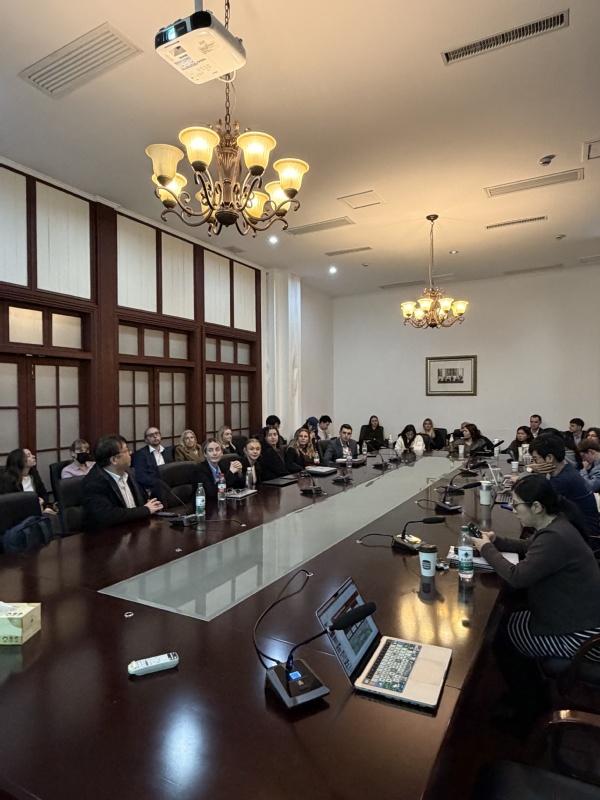
On the afternoon of December 2, 2025, a delegation of students and faculty members from the University of Newcastle Law School, Australia, visited Guanghua Law School at Zhejiang University and held a seminar on student exchange, legal education, and practice. The visiting delegation included Associate Dean Professor Bing Li, Administrative Officer Ms. Donna Jamieson, and fourteen senior undergraduate students from the University of Newcastle.
Upon arrival, the delegation was warmly welcomed by Assistant Dean Professor Lvye Mou, Secretary of International Affairs Ms. Shuyue Pan, and Teaching Secretary Ms. Zhe Lin, who guided them on a brief tour of Guanghua Law School and introduced the school’s history and academic culture. The Newcastle students expressed great admiration for the learning environment at Guanghua Law School.

Subsequently, a formal exchange seminar was held in Room 208 of the Main Building. Ms. Shhuyue Pan extended a warm welcome to the delegation from the University of Newcastle, and introduced the agenda of the seminar, which included a special lecture titled “If the World is a Family” delivered by Professor Ying Bi from the Institute of International Law.
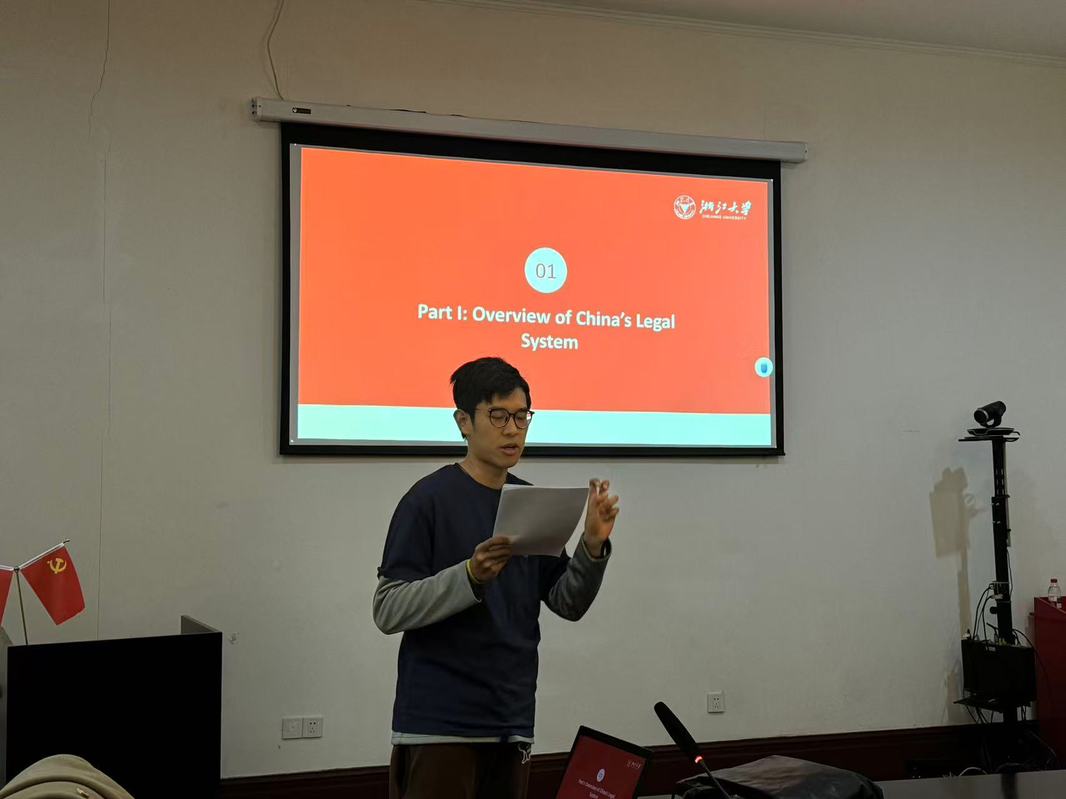
The seminar began with a presentation by Mr. Zhenghao Liu, a senior student from Guanghua Law School, who introduced the structure and practical application of China’s civil and commercial law system. The students from Newcastle showed great interest in the topic, actively engaging with questions and discussions with their counterparts from Zhejiang University.
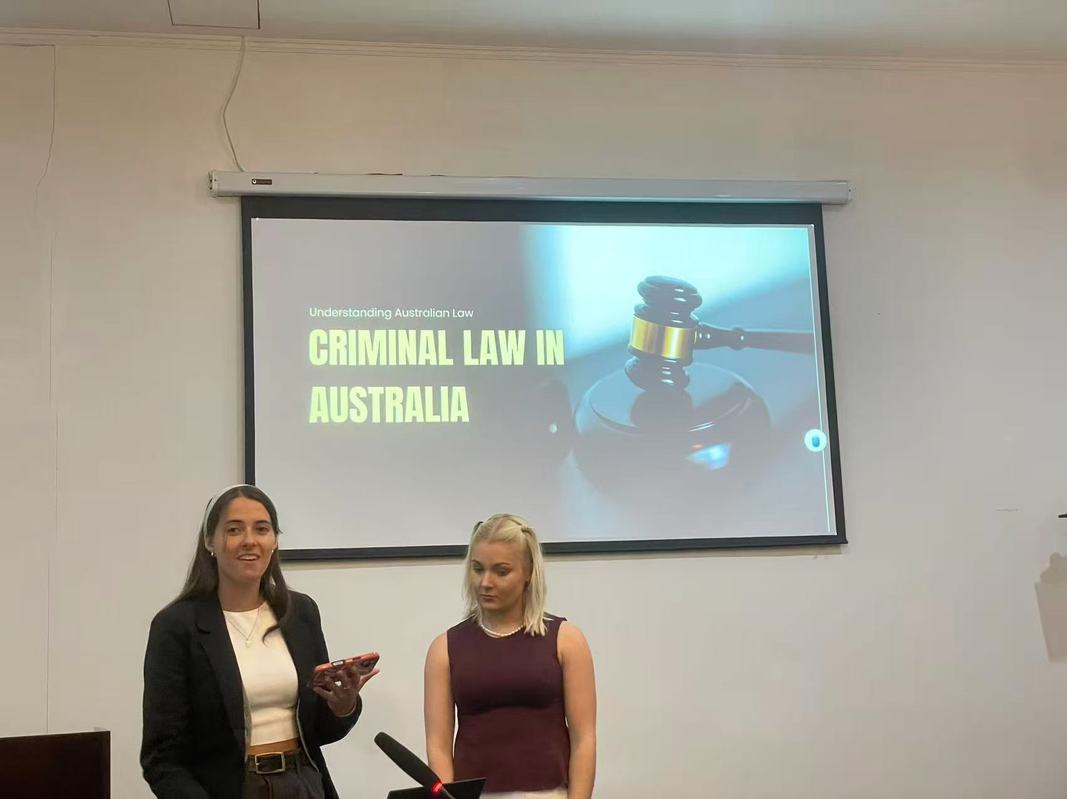
Following that, the fourteen students from the University of Newcastle were divided into seven groups, each introducing different branches of the Australian legal system, including intellectual property law, criminal law, and administrative law, among others. Among these, Native Title Law—a unique legal framework in Australia—aims to recognize and protect the land rights of Indigenous peoples.
Through a presentation on the landmark Mabo case of 1992, the students clearly illustrated how the ruling overturned the colonial concept of terra nullius (“land belonging to no one”) and affirmed Indigenous Australians’ rights to use, control, and manage their traditional lands, as well as to maintain their cultural practices.

In addition, the seminar featured a special discussion session as part of Professor Bi’s international law course, titled “If the World is a Family.” The session centered on Professor Susan Marks’ paper from the London School of Economics, If the World Is a Family, What Kind of Family Is It?, around which students engaged in critical discussions and presentations.
A student from Pakistan began the session by applying British philosopher Max Black’s “interaction theory of metaphor” to analyze the metaphoric relationship between “world” and “family.” In this reading, the world is seen as a naturally unified, hierarchical, and caring system, while the family is understood as a stable and universal social institution grounded in biological relations.
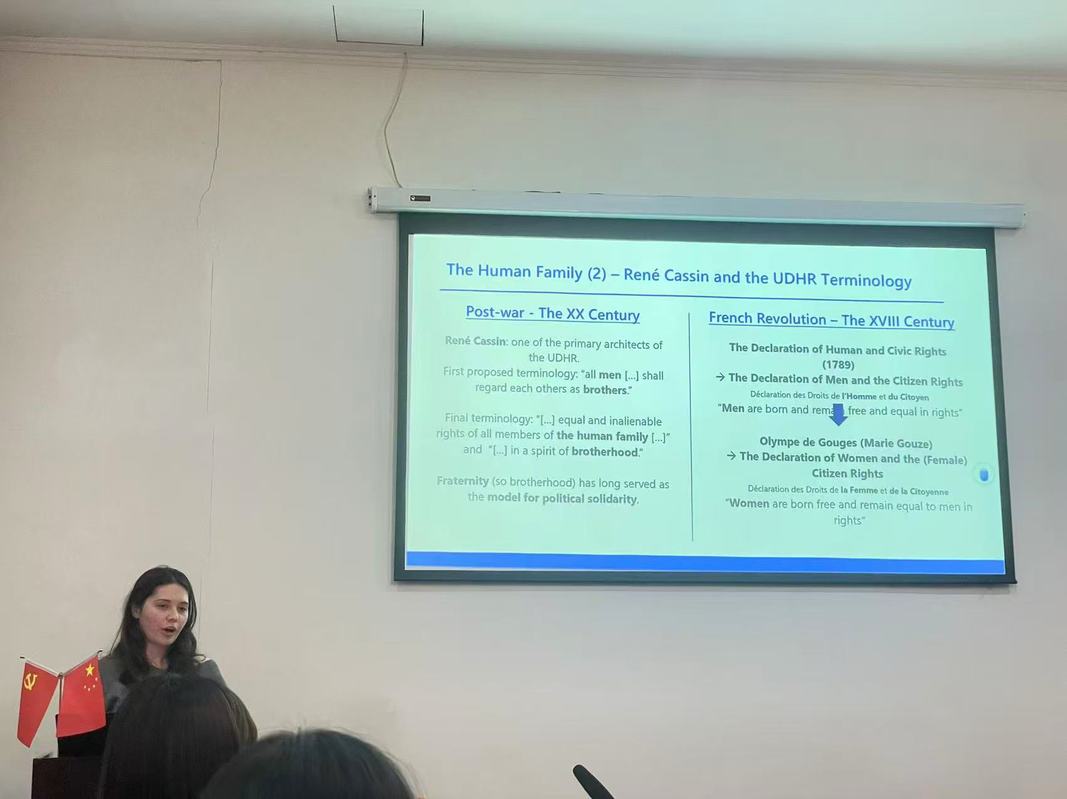
Following that, a student from France traced the genealogy of the term “Human Family” in postwar international discourse, beginning with French philosopher René Cassin’s early contribution to the drafting of the Universal Declaration of Human Rights (UDHR)—specifically, his notion that “all human beings… should regard one another as brothers.” The presentation examined how this idea evolved from the spirit of “fraternity” in the French Revolution, to the UDHR’s 1948 formulation—“the equal and inalienable rights of all members of the human family”—and later to MoMA’s 1955 global photography exhibition The Family of Man, which brought together works from 68 countries. The students systematically explored the historical evolution and political symbolism of this concept.
The presentation further examined the hierarchical structure implied in the term “The Family of Nations,” in which men are portrayed as decisive actors, women are marginalized as observers, and children are expected merely to obey and be disciplined. The students analyzed how this gendered political perspective is embodied and transformed within national narratives, drawing on the lyrics of the French national anthem La Marseillaise: “Do you hear…the roar of those fierce soldiers? They are coming right into our arms to cut the throats of our sons and wives.”
They then discussed the painting Liberty Leading the People by the French Romantic artist Eugène Delacroix, interpreting the image of the female figure of Liberty—raising the flag amid the revolution—as a symbol of shifting gender politics, where womanhood transforms from a passive emblem into an embodiment of freedom and resistance. By comparing this example with the Confucian moral framework of the Three Bonds and Five Relationships in Chinese philosophy, students from around the world reflected on how different cultural traditions intersect and redefine the meanings of “world” and “family” in a global context.
After the presentations, Professor Li introduced the University of Newcastle Law School’s long-standing program, the Law Clinic, a legal aid platform jointly operated by faculty and students. He emphasized that legal education at Newcastle values not only theoretical learning but also the practical application of law in real-life contexts. This approach helps students understand the social role of law from the undergraduate level. Two Newcastle students then delivered a lively demonstration of a Law Clinic session: one acted as a volunteer, while the other played a client seeking advice on marriage and property issues. Through vivid role-play, they showcased how to maintain professionalism and provide effective legal assistance during consultations.


They then discussed the painting Liberty Leading the People by the French Romantic artist Eugène Delacroix, interpreting the image of the female figure of Liberty—raising the flag amid the revolution—as a symbol of shifting gender politics, where womanhood transforms from a passive emblem into an embodiment of freedom and resistance. By comparing this example with the Confucian moral framework of the Three Bonds and Five Relationships in Chinese philosophy, students from around the world reflected on how different cultural traditions intersect and redefine the meanings of “world” and “family” in a global context.
After the presentations, Professor Li introduced the University of Newcastle Law School’s long-standing program, the Law Clinic, a legal aid platform jointly operated by faculty and students. He emphasized that legal education at Newcastle values not only theoretical learning but also the practical application of law in real-life contexts. This approach helps students understand the social role of law from the undergraduate level. Two Newcastle students then delivered a lively demonstration of a Law Clinic session, with one acting as a volunteer and the other playing a client seeking advice on marriage and property issues. Through vivid role-play, they showcased how to maintain professionalism and provide effective legal assistance during consultations.
Photos/ Zhenghao Liu
Texts/ Shuyue Pan