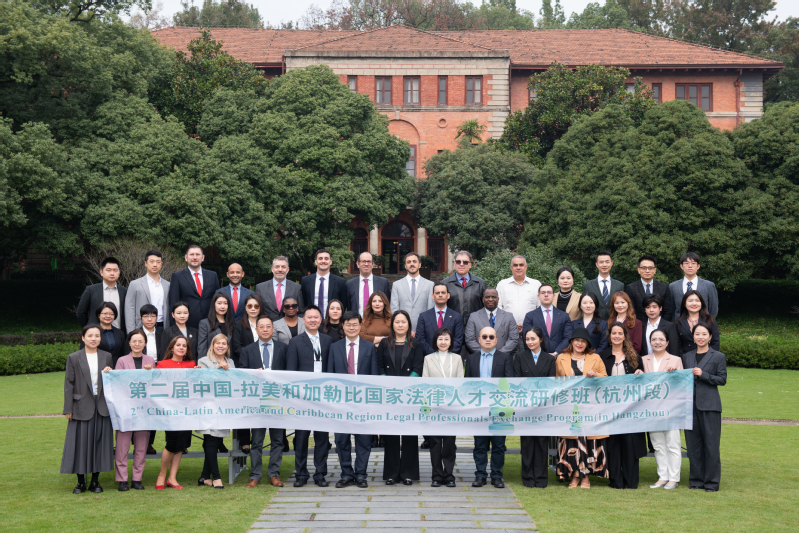
On the morning of November 10, the opening ceremony of the Second China–Latin America and Caribbean Legal Professionals Exchange and Training Program (Hangzhou Session) was grandly held at Zhijiang Campus of Zhejiang University. The program was organized by the China Law Society and co-hosted by Guanghua Law School of Zhejiang University, the Institute of Foreign-Related Rule of Law at China University of Political Science and Law, and the Law School of Shanghai University of Finance and Economics. It aims to promote in-depth exchanges in the legal field and inject legal momentum into the high-quality development of China–Latin America relations.
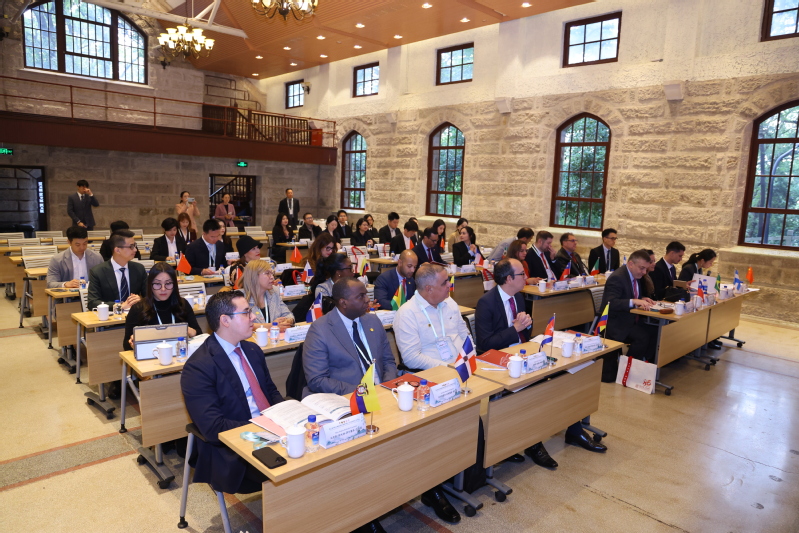
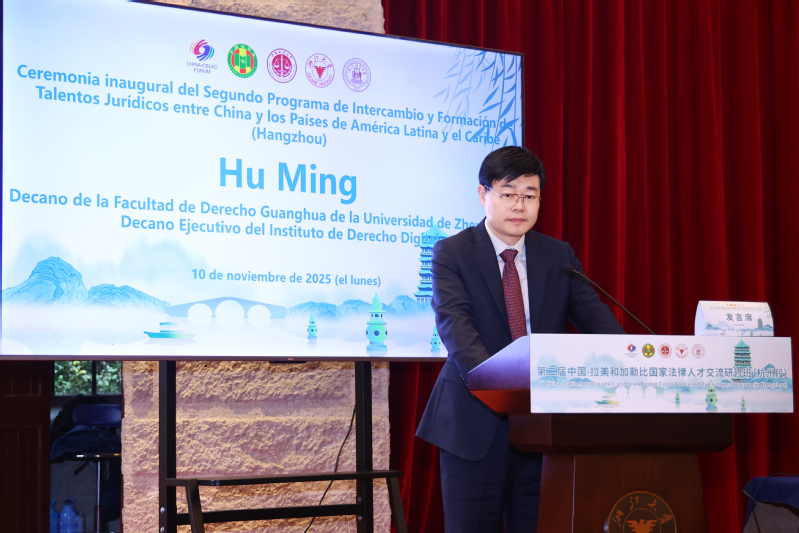
Jin Nan, Second-Level Inspector (in charge) of the Department of International Liaison of the China Law Society; He Peng, Director of Division II and First-Level Researcher of the same department; Zhang Lina, Director of the Office of Continuing Education Administration at Zhejiang University; and Hu Ming, Dean of Guanghua Law School of Zhejiang University, attended the opening ceremony. The ceremony was moderated by Zheng Lei, Vice Dean of Guanghua Law School.
A total of 22 legal professionals—including judges, prosecutors, lawyers, arbitrators, mediators, legal scholars, and in-house counsels—from 11 countries, namely Argentina, Brazil, Chile, Colombia, Cuba, the Dominican Republic, Ecuador, Guyana, Mexico, Panama, and Jamaica, participated in the program. The opening ceremony was fully supported by simultaneous interpretation in Chinese and English, reflecting respect for cultural diversity.
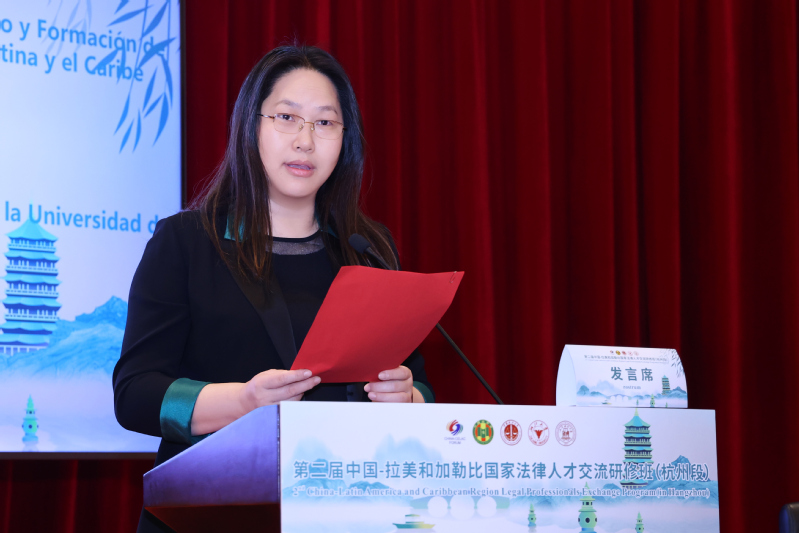
In her welcome address, Zhang Lina noted that law is the cornerstone of national governance and an essential safeguard for transnational cooperation in the context of globalization. She emphasized that although China and Latin America are geographically distant, their economic, trade, and people-to-people ties have grown increasingly close. Deepening the comprehensive partnership requires the alignment of legal systems and the improvement of the rule-of-law environment. This training program, she remarked, is a concrete effort to strengthen legal exchanges between China and Latin America and to consolidate the legal foundations of cooperation. She expressed hope that through this program, participants would not only expand their professional knowledge but also forge lasting friendships, laying a solid foundation for future rule-of-law cooperation and mutual exchanges between the two sides.
In his remarks, Hu Ming introduced the development history and disciplinary strengths of Guanghua Law School. He stated that holding the program in Hangzhou not only marks a new stage in China–Latin America cooperation in training legal professionals, but also reflects trust in Zhejiang University’s capacity for international exchange. Over the coming week, the Law School will draw on its strengths in talent cultivation, research innovation, and international cooperation to deliver the program through expert lectures, roundtable discussions, and site-based teaching. The curriculum will focus on themes such as “China’s Legal System for Digital and Network Governance,” “Globalization and International Rule of Law,” and “Rule-of-Law Cooperation under the China–Latin America Belt and Road Initiative.” He further emphasized that he hopes participants will deepen their understanding of China’s rule-of-law practices through this program, promote new breakthroughs in China–Latin America legal cooperation, and contribute insights to mutual learning among global legal civilizations.
Following the opening ceremony, the first lecture was delivered by Cheng Le, Executive Vice Dean, Professor, and PhD Supervisor of the Institute of International Strategy and Law at Guanghua Law School, Zhejiang University. Titled “Innovation and Practice of China’s Legal Framework for Digital and Network Governance,” the lecture drew on cases from China’s digital economy to analyze cutting-edge legal explorations in areas such as data security and the regulation of artificial intelligence. Throughout the session, participants remained highly attentive and engaged, frequently taking notes on key points and insightful perspectives.
Through lectures, thematic seminars, and field visits, the training program has enabled participants from Latin America to gain a more systematic and multidimensional understanding of the socialist rule-of-law system with Chinese characteristics. It is also hoped that the program will further deepen and institutionalize China–Latin America cooperation in the field of the rule of law. Participants generally agreed that legal cooperation has become a vital pillar of the China–Latin America comprehensive strategic partnership and should be continuously strengthened and expanded to provide intellectual and legal support for the joint construction of the Belt and Road Initiative. Experts attending the program concurred that, as cooperation between China and Latin America in trade, technology, and social governance continues to deepen, demand is growing for legal services in areas such as dispute resolution and intellectual property protection. Continued efforts to leverage the training program as a bridge and link will help build a rule-of-law support framework for a China–Latin America community with a shared future and promote coordinated development in global governance, international rule of law, and mutual learning among civilizations.