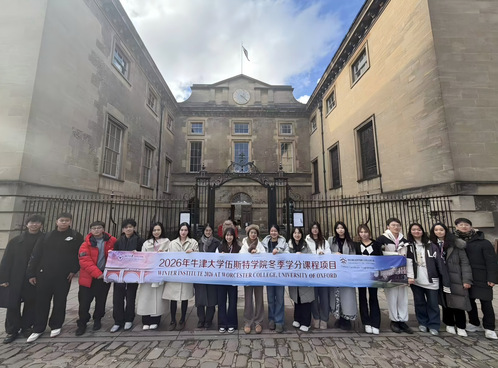
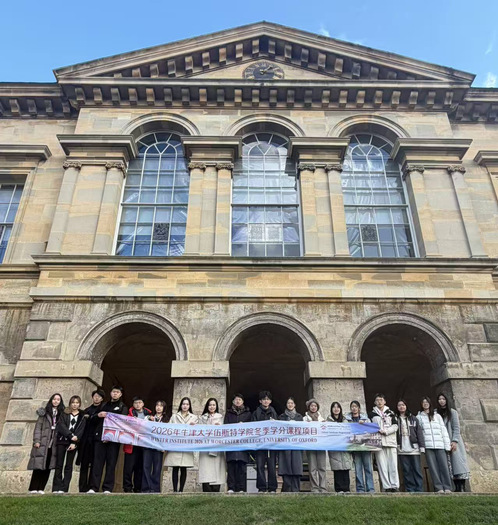
To comprehensively broaden students’ international horizons, enhance their comprehensive qualities, and deepen their understanding of common law theory and practice, from January 25 to February 6, 2026, Zhejiang University Guanghua Law School organized faculty and students to participate in the 2026 Oxford University Worcester College Winter Credit Course Program at Worcester College, Oxford University, UK. This program attracted over 100 students from Zhejiang University, China University of Political Science and Law, Southwest University of Political Science and Law, and other institutions. A total of 17 students from our school participated in this program, led by Professor Wang Shujian.
Part 1: First Encounter with Oxford––A Winter Invitation from the Foggy City
On January 26, under the guidance of Worcester College faculty, students attended a brief introduction to Oxford University, covering its historical evolution, educational conditions, and cultural traditions. Oxford University is the oldest university in the English-speaking world, with records of teaching dating back to 1096. The university comprises 39 constituent colleges, each with its own independent management structure and financial support, enjoying a high degree of autonomy. Each college possesses its unique traditions and culture, and this traditional collegiate system is one of Oxford’s core characteristics.
Worcester College is known as one of Oxford’s oldest colleges, with a history traceable to the 13th century. In 1283, the Benedictines established Gloucester College here, and it was officially named “Worcester” in 1714. The college boasts rare expansive lawns, towering ancient trees, and a football pitch, with all grass meticulously trimmed. Seagulls stroll across the football pitch in front of the teaching buildings. The college is equipped with a chapel, library, dining hall, and dormitories—these four facilities are considered essential components of any college.
Oxford town itself is a quaint, historic town without high-rise buildings, featuring mostly brown, three-to-four-story structures that create an overall sense of stable order.
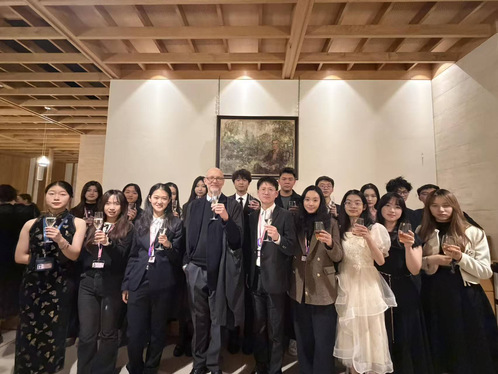
In the evening, students attended the welcome reception in formal attire, engaging in relaxed conversations about academics and life with classmates from around the world. On behalf of Zhejiang University Guanghua Law School, Professor Wang Shujian presented commemorative badge sets and exquisite bookmarks to Professor Benjamin Morgan, Co-Director of the Certificate Courses at Worcester College, Oxford University, and other faculty members. This event not only enriched students’ extracurricular lives but also provided a valuable social platform, promoting exchange and cooperation among students from diverse cultural backgrounds.
Part 2: Academic Exploration—In-depth Study of the Common Law System
The academic curriculum of this winter program covered multiple fields including commercial law, arbitration law, and corporate finance law, taught by renowned Oxford University professors.
Dr. Natalie Mrockova delivered a series of lectures on commercial law. The course content included contract law, company law, and corporate finance law. Using vivid and concrete examples, Professor Mrockova presented to students the meaning of offer and acceptance in the Anglo-American legal system. She used recent typical merger and acquisition cases as a framework to dissect legal risks and equity negotiations in capital restructuring and acquisitions.
Students were randomly divided into 6 groups, with 5 topics assigned to each group. Each student could choose a topic of interest within their group for reflection and present their learning outcomes in English. Some students focused on M&A cases from class, analyzing the legal boundaries of board decisions in friendly mergers versus hostile takeovers in light of Anglo-American case law traditions. Others selected jurisdiction disputes in cross-border transactions, exploring similarities and differences in contract interpretation rules across different legal jurisdictions. Still others approached from the perspective of corporate finance law, examining the impact of capital structure changes on creditors’ rights and disclosure obligations. Throughout, Dr. Mrockova listened attentively, and after each student’s presentation, she would pose questions based on the content or guide students to further consider the practical application of certain legal concepts. After all presentations concluded, Dr. Mrockova praised the students’ performance, noting that being able to clearly organize common law cases and express viewpoints in a non-native language within just a few days was itself an academic breakthrough.
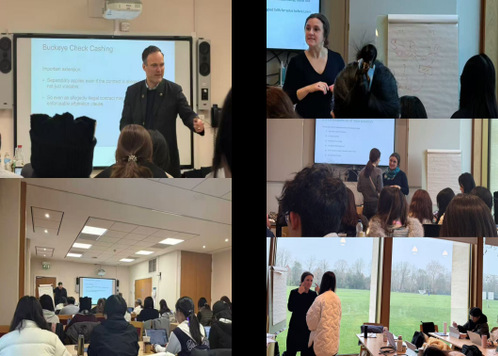
Dr. Andreas von Goldbeck taught the arbitration law course. This course was equally substantive and fast-paced. Before the examination, the professor continued lecturing enthusiastically, helping students consolidate core knowledge points such as the validity of arbitration agreements and jurisdictional objections. Using a marker, he sketched one case framework after another on the whiteboard. The final online examination used multiple-choice questions to awaken memories of the week’s learning, and through these questions, students finally achieved a comprehensive understanding of arbitration law.
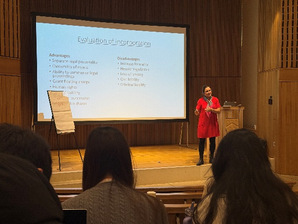
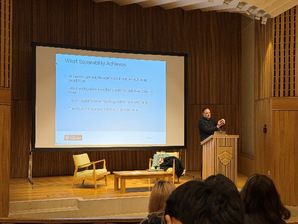
Additionally, the program arranged multiple interdisciplinary lectures: Professor Camilla Hyslop lectured on “Law and Climate Change Response”; Professor Neil Vulcan shared insights on “Artificial Intelligence and Finance”; Professor Alona Levko explored “Collaborative Leadership and Ecosystem Construction”; Professor Olivia Doerschler delivered a thematic presentation on “Innovation Ecosystem Construction Under Resource Constraints—A Case Study of the Himalayan Region”; Professor Simon Cowan conducted an economics-themed activity on “Games, Voting, and Tariffs,” using the classic “guess the number game” to allow students to experience the game theory logic of multi-level thinking and common knowledge; and Professor Keith Hawkins presented on “Crime and Punishment,” examining punishment mechanisms from legal and social dimensions.
Part 3: Cultural Immersion—History Lessons on Foot
First Visit to the Small Town: Cambridge
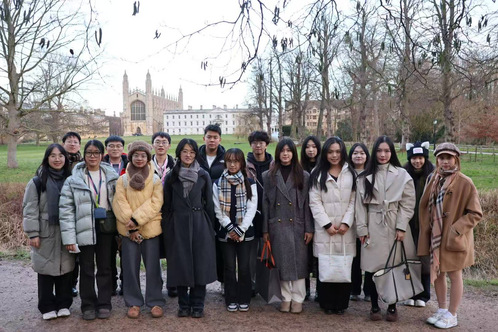
Students traveled by coach to Cambridge. They focused their visit on Queens’ College. Founded by two queens, the college has a history of over six hundred years, with classical architecture complementing the scenery of the River Cam, and landmarks such as the Mathematical Bridge leaving deep impressions. Students walked and listened, photographed and took notes, immersively experiencing Cambridge’s humanistic heritage and academic atmosphere. Unlike Oxford’s “dreaming spires,” Cambridge feels more serene and elegant, with punting boats on the River Cam, golden willows along the banks, and sunset scenes composing a typical British academic landscape. Through comparison, students came to appreciate the different temperaments of these two top institutions: Oxford is solemn and ancient, while Cambridge is lively and beautiful, yet both carry profound academic traditions and humanistic spirit.
Artistic Treasures at the Ashmolean
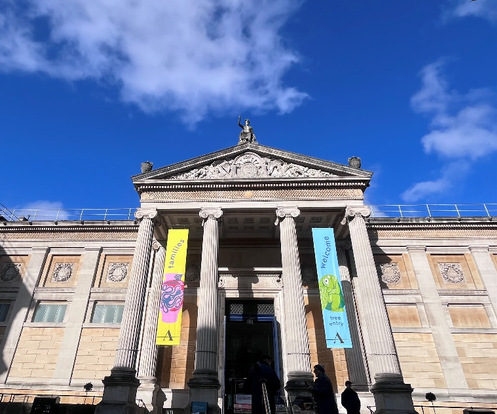
On the morning of February 2, students visited the Ashmolean Museum. Founded in 1683, it is Britain’s first public museum. Its collections span from Egyptian mummies, Greco-Roman classical sculptures, and masterworks of European art to the most extensive collection of Chinese art in the Western world. The 2013 donation of the Michael Sullivan Collection of Contemporary Chinese Art (over 400 works) made students feel particularly connected, making this not merely a visit but a cross-cultural dialogue.
Natural Scenery: Botanical Gardens and Magdalen College, Oxford University
On the morning of February 3, students visited the Oxford Botanic Garden and Magdalen College, Oxford University. Founded in 1621, the Oxford Botanic Garden is Britain’s oldest botanical garden. Although it was winter, seasonal displays of citrus, bougainvillea, and primroses in the greenhouses still allowed students to feel the resilience of life. Magdalen College left a deep impression on students: the Magdalen Tower, built in 1509, stands 144 feet tall and is an important component of the Oxford skyline; the college is also renowned for its cloisters in the Perpendicular Gothic style and its 15th-century chapel. Addison’s Walk, where C.S. Lewis once strolled and found inspiration for his writing, was traversed by students attempting to sense the literary master’s thoughts of that era.
Part 4: Graduation Ceremony—Successful Conclusion of the Program
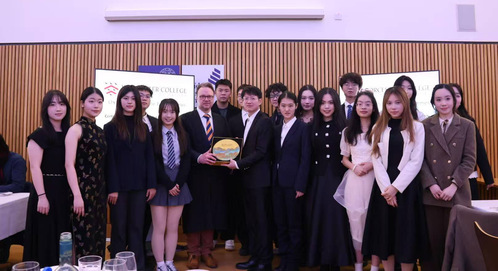
On February 5, the winter program held its graduation ceremony. In the evening, students gathered in formal attire at the Oxford University banquet hall. Before the ceremony, on behalf of Zhejiang University Guanghua Law School, Professor Wang Shujian presented souvenirs to Dominic Wanner, Program Director at Worcester College, Oxford University.
At six-thirty, the graduation ceremony began promptly, with dark golden light streaming across the long tables and bubbles rising finely in champagne glasses. At seven-thirty, the certificate presentation commenced. Students came from all corners—Beijing, Hangzhou, Nanjing, Chongqing, Ningbo—and even included several young professionals. Ten days prior, they had been merely unfamiliar names on a list; ten days later, when someone’s name was called, it would always elicit a burst of friendly cheers.
Conclusion
The dozen or so days at Oxford Winter School were an intertextuality of legal logic, textual history, and pure sound—a brief yet precious winter memory. From the nervousness of first arrival to the growth and transformation of a composed farewell, students at thirty thousand feet carefully folded away the rain of Oxford, the bells of Worcester, and this winter, tucking them into the softest corners of memory to bring home.
On February 6, students departed for their return journey. From Oxford to Heathrow Airport, the English countryside outside the window appeared particularly gentle in the rainy mist. Through systematic academic courses, rich cultural visits, and in-depth cross-cultural exchange, this Oxford Winter Program not only enhanced students’ professional competence but also broadened their international perspectives and deepened their understanding of different legal systems and cultural traditions. The program concluded successfully, but the winter days spent at Oxford will become precious memories in students’ academic careers.