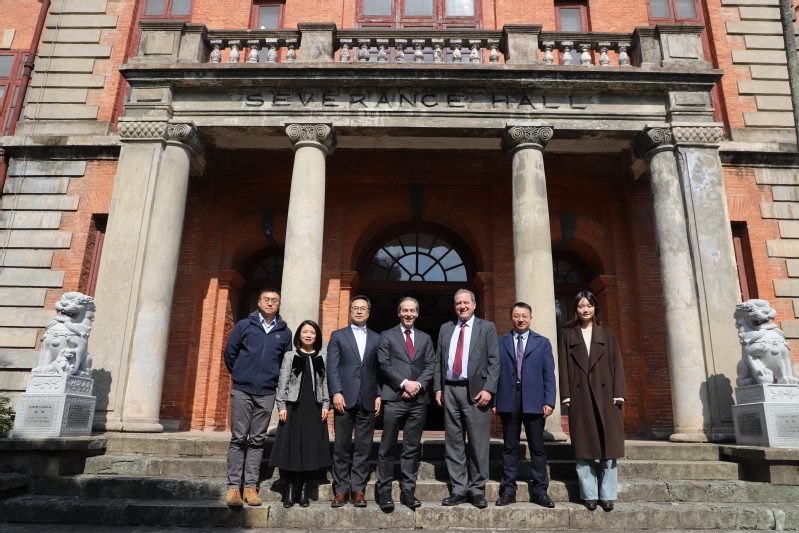
On the morning of March 11, 2026, a delegation consisting of Professor Andrew Perlman, Vice President of Suffolk University, Professor Charles Wang, Vice President of Golden Gate University, and Professor Marc L. Miller, former Dean of the College of Law at University of Arizona, visited Zhejiang University Guanghua Law School. During the visit, the two sides held discussions on academic collaboration, artificial intelligence, and legal education.
Upon their arrival at the Law School, Professor Chunyan Zheng, Vice-Dean and Secretary of the Party Committee of Guanghua Law School, warmly welcomed the delegation. Also attending the meeting were Vice-Dean Yubing Shi, Assistant Professors Wenlong Li and Yiquan Wu from the Research Institute of Digital Rule of Law, as well as International Affairs Secretary Shuyue Pan.
The two sides held discussions in Meeting Room 208 of the Main Building. Vice-Dean Shi first introduced the Law School’s disciplinary development, talent cultivation, and international exchange and cooperation.
Professor Andrew Perlman then presented an overview of Suffolk University, including its academic reputation and ranking in the field of legal education in the United States. He noted in particular that the law school is located in downtown Boston, in close proximity to many renowned universities, courts, law firms, and government institutions. This unique location, he explained, enables the school to serve as an important platform connecting legal education with practice and provides students with abundant internship and career development opportunities.

After introducing the program, Professor Perlman turned to the impact of artificial intelligence on the legal profession. He shared an interaction he once had with ChatGPT: in an experiment, he uploaded a photograph of an ordinary house, and the system was able to identify its precise geographic location by analyzing details in the image. Using this example, he raised a question: as artificial intelligence begins to surpass humans in certain problem-solving abilities, what kind of future might await the field of law—a discipline traditionally grounded in professional judgment and reasoning?

Building on this question, he further asked how the boundary should be drawn in future legal practice between AI as a tool for problem-solving and AI as a decision-maker. Professor Andrew Perlman noted that understanding this distinction is crucial for rethinking the competencies required of legal professionals, the models of legal education, and the ethical frameworks governing the legal field.
Professor Marc L. Miller then continued the discussion from the perspective of education. He observed that artificial intelligence has already deeply permeated the environment in which the new generation of students grow up. While educators remain open to the use of AI as an assistive tool, a more fundamental question remains: how can students maintain independent thinking and judgment while using these technologies?

To further explicate this issue, Professor Marc L. Miller referred to a well-known discussion in classical philosophy. He noted that in ancient Greece, Socrates once expressed concern about the spread of “the written word”. Socrates believed that once knowledge was recorded in written texts, memory would be outsourced to the page, and people might stop exercising their own capacity for remembering.
Professor Miller suggested that this concern bears striking similarities to contemporary anxieties about artificial intelligence. When large language models (LLMs) are able to produce answers rapidly, people worry that they may become a substitute for human thinking. Yet, in a certain sense, artificial intelligence may be closer than “the written word” to the dialogical form of thinking that Socrates valued. Writing is one-directional—it can be read but cannot respond to the reader. By contrast, interactive AI systems such as ChatGPT can engage in dialogue: they not only answer questions but can also ask follow-up questions and challenge a user’s assumptions.
Following this reflection, Professor Yiquan Wu and Professor Wenlong Li responded to Professor Miller’s remarks with concrete examples. Professor Wu observed that a new generation of students has gradually become accustomed to using artificial intelligence as a learning aid. In law schools, for instance, students can use AI to simulate roles such as lawyers or judges. Such platforms are beginning to reshape the traditional law clinic model, enabling students to encounter legal scenarios they may face in practice at a much earlier stage of their training.
Professor Wenlong Li then introduced another set of questions concerning artificial intelligence, copyright, and authorship. When machines generate content by learning from human-created works, who should be considered the “author”? Who should bear legal responsibility? Addressing these questions, he suggested, is not only about interpreting existing legal frameworks but also about considering how the law itself may evolve in response to new forms of creativity shaped by AI.

Finally, Vice-Dean Shi Yubing, Professor Charles Wang, Professor Andrew Perlman, and Professor Marc L. Miller discussed possibilities for future collaboration. The two sides exchanged views on potential initiatives including academic cooperation and scholarly exchange, and expressed a shared willingness to further develop institutional partnerships.
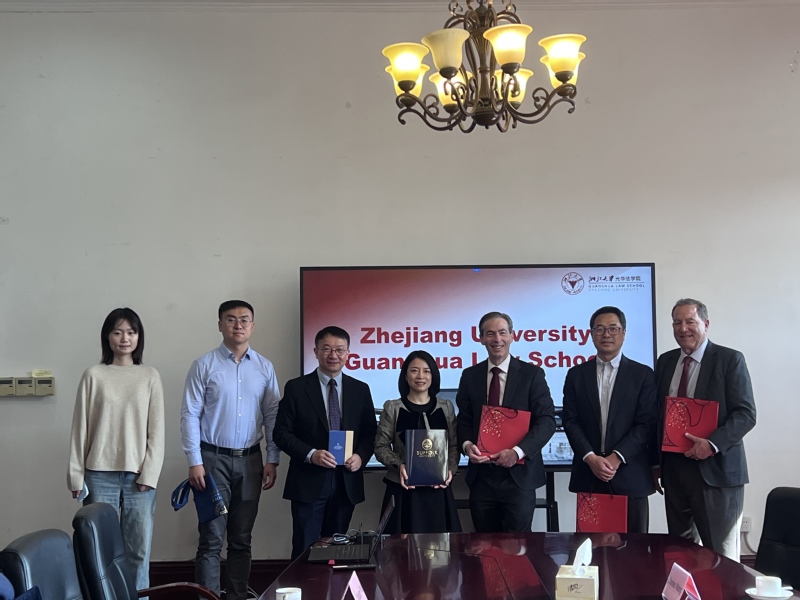
The meeting concluded successfully. Held in the form of a roundtable discussion, the event not only built a solid bridge for future collaboration but also offered an opportunity to reconsider the evolving relationship between legal studies and artificial intelligence. It invites us to reflect on how the role of media in the production of knowledge may need to be reinterpreted in a new technological context. In this sense, artificial intelligence in contemporary society may resemble the written word in the time of Socrates, or the relationship between the camera and photography and the tradition of painting.
Looking back at history, every transformation in information media has been accompanied by similar anxieties: people fear that new technologies might weaken memory, replace human thinking, or even reshape the foundations of existing disciplines. Yet artificial intelligence may be more than a technological tool that challenges legal practice and legal education. It also serves as an important opportunity to explore new possibilities and, in the process, to rethink modes of knowledge production and the boundaries between disciplines.
Images/ Rong Li
Texts/ Shuyue Pan